
7 READ-TIME
Key Seedling Cereal Pests: From Cutworms to Seedling Diseases
March 3, 2021
From cutworms to seedling diseases, growing cereal crops in Western Canada has its fair share of challenges especially when it comes to dealing with various pests. In this article, we'll dive into the different seed diseases and insect threats that can hinder your crop’s development and yield potential. We'll cover common culprits like Cochliobolus sativus and Fusarium species that cause seed rots and root rot, as well as bacterial and fungal diseases such as Pythium root rot, bacterial streak, and smut. Additionally, we'll discuss insect pests like cutworms and wireworms that can wreak havoc on your cereal crops.
But don't worry – we'll also guide you through practical steps to protect your cereal crops, with a focus on the importance of seed treatments. Let’s get started on safeguarding your cereal crops for a healthier, more profitable harvest!
Seedling and Seed Diseases: Cochliobolus, Fusarium, Pythium, and More
Seed rots, seedling blight and common root rot are part of the cereal seedling disease complex in Western Canada caused primarily by Cochliobolus sativus (C. sativus) and multiple Fusarium species. These pathogens can be both seedborne and soilborne. Seed becomes infested when spores released from infested plant tissue or residues land on the developing heads and infect the structures. Highly infested seeds often have lower germination and vigor and are more susceptible to seed rot.
It is not unusual for the infection to move from the seed to the seedling, causing lesions or necrosis of the developing roots and coleoptile which may lead to seedling death before emergence or shortly after. Infections caused by soilborne spores or mycelia arising from plant residues may cause similar symptoms. Above-ground symptoms are often nondescript and may include stunting, chlorosis, reduced tillering, smaller heads and premature ripening. The impact of these diseases may be exacerbated when hot and dry conditions persist through flowering and grain fill. Yield losses are variable but losses up to 17% have been reported.1
For additional resources on identifying diseases in specific crops like wheat, explore this resource on Disease Identification and Management in Wheat.
Cochliobolus sativus only infects cereals and is most often associated with common root rot, which can be diagnosed by the presence of distinct, dark brown lesions on the roots and, in particular, on the subcrown internode. Most Fusarium species are capable of infecting multiple host species including cereals, pulses, and canola. Early root symptoms may show a reddish brown discolouration without a distinct margin and cracks may appear along the main roots.
Fusarium root rots and Fusarium head blight (FHB) are often caused by the same pathogens but represent different stages of the same disease cycle. Although Fusarium graminearum (F.graminearum) is most commonly associated with FHB it is not the only Fusarium species to infect kernels and affect seed performance. It is therefore important when considering a disease test result that the total amount of Fusarium present in the seed, regardless of species, is used to assess the risk associated with that seed. The pathogen’s preferred environmental conditions are highly variable depending on species, but disease severity tends to increase with intermittent wet/dry cycles.
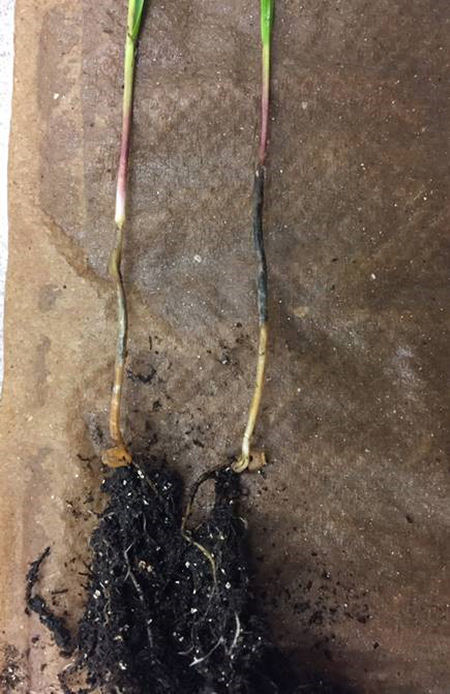
Figure 1. Seedlings infected with C. sativus showing characteristic lesions on the subcrown internode.
Pythium species also cause seed rot and root rot. Browning root rot or Pythium root rot is a soil-borne disease and is most detrimental in cold, wet soils. Seedlings may be chlorotic or have purpling, similar to nutrient deficiencies, and root tips and lateral roots may appear pruned or absent. Generalized stunting as the crop develops is common. Symptoms will be most obvious in low lying areas where moisture collects. Management includes soil drainage, adequate phosphorous fertility, and seed treatment.2
Bacterial streak and black chaff caused by Xanthomonas translucens pv. undulosa occur sporadically but are becoming more prevalent in Western Canada. These bacteria are primarily seedborne but will overwinter in crop residue. Seed treatments and foliar fungicides are not effective in controlling this disease and commercial seed tests are not yet available to identify infested seed lots. Awareness is key to preventing the spread of this disease which can spread by contact with people or equipment or by planting infected seed. The symptoms appear on leaves as light green water-soaked spots or streaks becoming yellow and necrotic. A yellowish discharge from the leaf, typical of bacterial infection, is a key identifying feature when present. Seed heads of cereal crops can also be infected by this pathogen though the symptoms appear on the glumes as dark lines and severe infection can entirely blacken glumes.3
Smut is a disease of concern in all cereals, but especially in barley. Of the smuts, true loose smut is the most problematic as it is carried internally within the seed embryo instead of on the seed surface. As the seed germinates the pathogen also activates, colonizing the developing plant tissues as the plant grows. If the pathogen successfully keeps up with the growing tip of the plant it invades and replaces the kernel structures in the developing heads. Conditions that slow plant growth, such as extended periods of cool temperatures, increases the chance of the smut replacing the head structures. Smut can be managed by selecting resistant varieties, selecting a seed lot that is smut-free, and including a systemic fungicide seed treatment.4
Wireworms
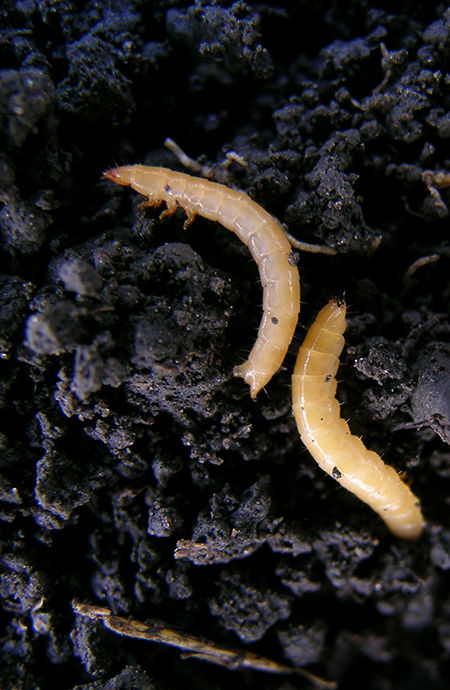
Figure 2. Wireworm
Photo courtesy of John Gavloski, Manitoba Agriculture and Resource Development.
Wireworm densities can vary greatly from field to field, and this pest is found in both Western Canada and Eastern Canada. They are typically found on silty, medium textured, well-drained soils, though they are not limited to these soil types.5 Wireworms feed on grasses, so they can be a serious pest on perennial grassland that has recently been broken for annual cropping. Wireworm populations can also build up in land that has been in annual crop production for several years.6 Wireworm feeding on roots and seeds may appear as bare patches or as stand reduction. Scout by doing plant stand counts throughout the field and comparing to the targeted plant stand. If there are bare patches, look for wireworms by digging around bare patches and sifting the soil. Bait balls may also be used to determine if wireworms are present.7 If wireworms are found, control measures may be needed.
Cutworms
It is important to watch for cutworms early in the season. Armyworm, darksided cutworm, dingy cutworm, redbacked cutworm, and variegated cutworm can impact cereal crops across the Prairies. Additionally, the army cutworm and pale western cutworm prefer the arid conditions of southern Alberta and Saskatchewan. The black cutworm prefers moist conditions in Manitoba.8 In an outbreak, cutworms can cause devastating crop destruction. Outbreaks can be local or cover a large area over several years. In contrast to wireworm feeding, cutworms chew mainly on stems and leaves of cereal crops. Heavy cutworm damage can result in bare patches. In order to differentiate between cutworm and wireworm damage it is best to dig around the damaged plants and find the pest. The key difference between cutworm and wireworm larvae are the legs. Both wireworm and cutworm have three pairs of legs behind the head, but cutworm also have five pairs of prolegs on the abdomen.7
Cutworm management for specific crops is important to get ahead of before there is considerable yield loss.
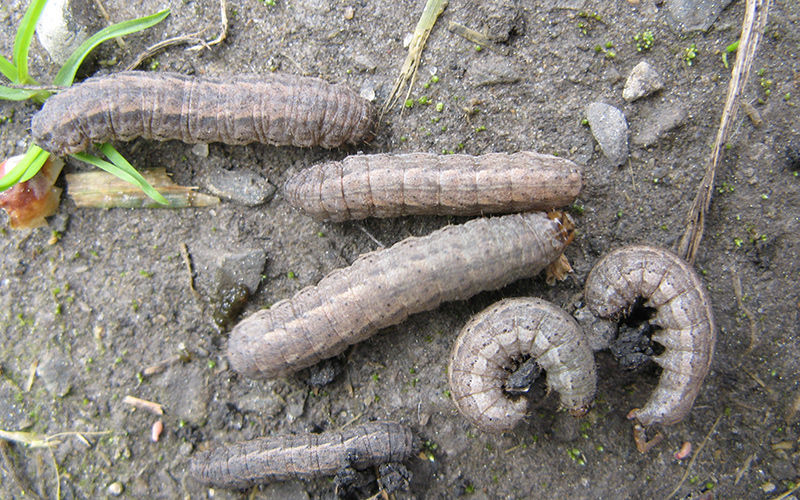
Figure 3. Cutworm with prolegs visible on abdomen.
Photo courtesy of John Gavloski, Manitoba Agriculture and Resource Development.
Management and Next Steps
Managing seedling and seed diseases and pests in cereal crops is crucial for ensuring healthy growth and maximizing yields. Throughout this article, we've discussed various challenges, and now, let's summarize the key recommendations and seed treatments to help protect your crops.
Disease Management:
- Nutrient Management: Proper fertilization, avoiding excessive nitrogen, is essential. This helps maintain a balance that supports healthy crop growth and resilience against diseases.
- Seed Placement: Avoid deep seeding to prevent seedling stress and vulnerability to pathogens.
- Soil Drainage: Ensure good soil drainage to reduce the incidence of diseases like Pythium root rot, which thrive in wet conditions.
- Disease Testing: Regular seed testing can identify the presence of pathogens such as cochliobolus sativus and Fusarium species. Use a germination test alongside a fungal scan to assess seed quality.
Insect Management:
- Crop Establishment: Seed shallowly into warm, moist soil to promote quick growth and minimize wireworm damage.
- Scouting and Monitoring: Regularly inspect fields for signs of pest damage. Use bait balls for wireworms and observe for cutworm activity.
- Biological Control: Maintain natural field boundaries to support predator insects that control cutworm populations.
Recommended Seed Treatments:
- Fungal and Bacterial Pathogens: Use Seed Treatments that are effective against seed-borne and soil-borne pathogens. Seed treatments can help increase germination rates and protect seedlings from diseases like common root rot and Fusarium.
- Pythium Root Rot: Ensure adequate phosphorous fertility and consider seed treatments designed to combat soil-borne pathogens.
- Smut: Select resistant varieties and use systemic fungicide seed treatments to protect against smut diseases, especially true loose smut in barley.
- Wireworms and Cutworms: Utilize insecticide seed treatments like Raxil® PRO Shield to protect against wireworm damage.
Cereal Growth Stages and the Application of Herbicides and Fungicides
By implementing these strategies and using the recommended seed treatments, you can effectively manage seed and seedling diseases and pests that threaten your cereal crops. Staying vigilant and proactive will help ensure a healthy, profitable harvest season.
Sources:
1 Fernandez, M.R., Conner, R.I., Agriculture and Agri-Food Canada, Swift Current, SK, Agriculture and Agri-Food Canada, and Morden, MB. 2011. Root and crown rot of wheat. Prairie Soils and Crops Journal, Insects and Diseases Volume 4.
2 Bailey, K.L., Gossen, B.D., Gugel, R.K., and Morrall, R.A.A. 2009. Diseases of field crops in Canada. Pg. 95.
3 Alberta Wheat Commission. 2020. Bacterial leaf streak and black chaff of cereal crops in the Prairies. https://www.albertagrains.com/the-growing-point/articles-library/bacterial-leaf-streak-and-black-chaff-of-cereal-crops-in-the-prairies.
4 Bailey, K.L., Gossen, B.D., Gugel, R.K., Morrall, R.A.A. 2009. Diseases of field crops in Canada. Pg. 37-38.
5 Alberta Government. 2014. AgriFacts: wireworm. https://open.alberta.ca/publications/7179888.
6 Gavloski, J., Meers, S., 2011. Arthropods of cereal crops in Canadian grasslands in Biological Survey of Canada. Ch. 9. p. 218-219. https://biologicalsurvey.ca/arthropods-of-canadian-grasslands/.
7 Manitoba Agriculture and Resource Development. Wireworms on crops in the Canadian prairies. https://www.gov.mb.ca/agriculture/crops/insects/wireworms.html.
8 Agriculture and Agri-food Canada. 2017. Cutworm pests of crops on the Canadian prairies- identification and management field guide.
Legal statements:
ALWAYS READ AND FOLLOW PESTICIDE LABEL DIRECTIONS. Performance may vary from location to location and from year to year, as local growing, soil and weather conditions may vary. Growers should evaluate data from multiple locations and years whenever possible and should consider the impacts of these conditions on the grower’s fields.
Raxil® is a registered trademark of Bayer Group. Used under license. Bayer CropScience Inc. is a member of CropLife Canada. ©2021 Bayer Group. All rights reserved. 4027_S1_CA.