Managing potato virus Y (PVY) in commercial potato production – Targeting aphid vectors with modern insecticides
June 3, 2025
Potato virus Y (PVY) remains one of the most significant disease threats to commercial potato production, affecting both yield and tuber quality. PVY infection can cause a range of symptoms, from mild mosaic patterns and leaf drop to severe tuber necrosis, depending on the strain and cultivar affected. The virus is primarily spread by aphids in a non-persistent manner, as well as through infected seed tubers, making early detection and effective vector control essential components of an integrated disease management strategy.
“Potato virus Y is a virus that only infects plants. Hosts and symptoms can depend on the strain, but it can infect pepper, tomato, tobacco and potato,” notes Justin Dalebozik, fruit and vegetable agronomist with Bayer. “In the field, it is usually part of a viral complex that can consist of several strains, for example, PVYO, PVYN:O and recombinant types like PVYNTN. Although not a new disease in potato, PVY has become an important disease in Canada as new strains are more aggressive.”
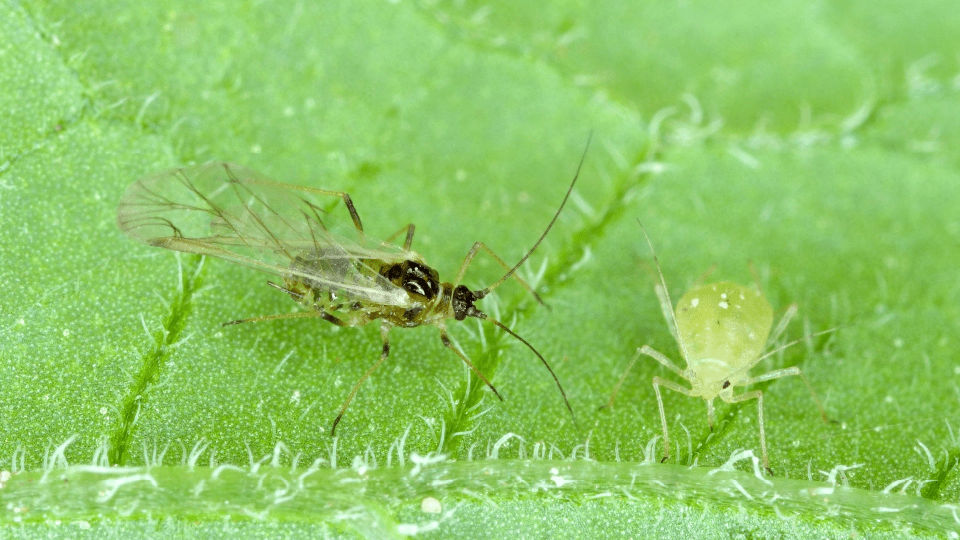
PVY is transmitted mainly by more than 50 species of aphids, with the green peach aphid (Myzus persicae) being the most efficient vector in many potato-growing regions. The virus is acquired and transmitted within seconds during brief feeding probes, meaning that rapid-acting insecticides and residual protection are critical to interrupt transmission cycles.
“Spread of PVY by aphids occurs when the virus sticks to the external mouth parts of aphids that have fed on an infected plant, and is passed to subsequent plants the aphids probe and pierce,” says Dalebozik. “The tiny punctures made by the aphids with contaminated mouth parts introduces the virus to the new host.”
“PVY damages the foliage of potato plants, reducing their photosynthetic capacity and subsequent yield. Foliar symptoms can include necrosis, leaf deformation, crinkling, chlorotic mottling, vein banding and stunted plants,” says Dalebozik.
“In addition to obvious above-ground signs of infection, reductions in marketable yield and quality of tubers can be caused by the viral infection itself,” he adds. “Tubers can develop necrotic ring spots or cracks on the surface, or necrotic lesions within the tuber, making them unmarketable.”
While complete eradication of aphid populations is neither practical nor necessary, reducing vector density during periods of high susceptibility (early vegetative stages and pre-senescent canopy development) significantly lowers the likelihood of PVY introduction and spread.
Sivanto Prime: Group 4D chemistry for rapid knockdown and residual control
Sivanto® Prime represents a novel Group 4D insecticide that offers rapid knockdown of aphids and leafhoppers, two critical insect vectors in potato production. Sivanto Prime is particularly effective against non-persistent virus vectors, thanks to its:
Translaminar movement, enabling control of pests feeding on the underside of leaves
Quick onset of action, minimizing the window in which aphids can acquire and transmit PVY
- Favourable selectivity profile, minimizing impacts on beneficial insects such as lady beetles and parasitic wasps, which help regulate aphid populations naturally
“Sivanto Prime is a nicotine acetylcholine receptor competitive modulator with the active ingredient flupyradifurone,” says Sherri Tedford, customer solutions agronomist with Bayer. “This means Sivanto Prime impairs muscle regulation, resulting in paralysis and death of insects.”
Sivanto Prime works via ingestion and contact with quick knockdown and feeding cessation of sucking pests, such as aphids. It is xylem mobile with translaminar and locally systemic movement, protecting the whole leaf after application, even the underside.
By integrating Sivanto Prime into their pest management program, growers can proactively suppress aphid vectors, reducing PVY transmission risk while maintaining beneficial insect activity – a key principle of integrated pest management (IPM).
Movento: Systemic protection and lipid inhibition mechanism
Another effective tool in PVY management is Movento® (spirotetramat), a Group 23 insecticide that offers two-way systemic action – moving both upward and downward within the plant’s vascular system. Movento’s mode of action targets lipid biosynthesis in aphids, inhibiting their ability to grow and reproduce. Although its onset is slower than that of Sivanto Prime, Movento provides longer residual control, making it ideal for:
Season-long aphid suppression, particularly when early-season populations are low
- Reducing secondary virus spread by controlling vector populations before they reach threshold levels
“Movento is an inhibitor of acetyl-CoA carboxylase, meaning it suppresses biosynthesis of fatty acids by the treated insect,” says Tedford. “In aphids, this can cause incomplete molting and death of immature stages among other effects on fecundity, fertility and survival fitness of progeny. It is a systemic product that works mainly through ingestion. It is phloem and xylem mobile with residual control, able to protect new growth.”
By disrupting aphid development, Movento indirectly suppresses PVY spread throughout the growing season, supporting a long-term management approach that complements more immediate control strategies.
Integrating aphid control into a PVY management plan
In field trials conducted by Gaia Consulting, both Sivanto Prime and Movento performed very well, according to Gaia Consulting president Darin Gibson.
“Sivanto Prime also controls leafhopper species which can cause hopper burn (particularly potato leafhoppers) or purple top (aster leafhopper),” notes Gibson. “Sivanto Prime also has the advantage of being effective at higher temperatures, whereas another insecticide group that is often used for leafhoppers (Group 3, pyrethroids) is less effective at temperatures over 27 C. Warm temperatures are prevalent when leafhoppers are most active in July and August.”
An effective PVY management strategy in potatoes must include both vector control and seed health practices, including the use of certified virus-free seed and regular monitoring. When incorporating chemical controls into the program, timing and mode of action rotation are essential to prevent resistance and ensure consistent protection.
Recommended strategy:
- Start with clean seed to reduce initial PVY inoculum
- Scout early and often for aphid activity and PVY symptoms
- Apply Sivanto Prime at the first sign of aphid pressure for rapid knockdown and short-term residual control
- Follow up with Movento if extended aphid suppression is needed later in the season
- Rotate chemistries and integrate non-chemical controls (e.g., reflective mulches, early harvest) as part of a broader IPM plan
PVY continues to evolve, presenting new challenges for potato producers across Canada and beyond. As the virus adapts and spreads more efficiently, control must be equally dynamic and strategic. Sivanto Prime and Movento represent two powerful tools in modern aphid and PVY management, offering complementary modes of action that target both the pest and its disease-spreading potential.
By combining seed health practices, vector control, and chemical rotation within an IPM framework, growers can reduce the incidence of PVY, protect crop quality, and sustain profitability in an increasingly challenging production environment.
ALWAYS READ AND FOLLOW PESTICIDE LABEL DIRECTIONS. Bayer, Bayer Cross, Movento® and Sivanto® are registered trademarks of Bayer Group. Used under license. Bayer CropScience Inc. is a member of CropLife Canada. ©2025 Bayer Group. All rights reserved.